Disclosure: Digital Business Card is an independent store. We work with several digital business card platform partners and may earn a commission when you buy through us. This never changes your price. This store sells a digital-only card. It sells no NFC card, and nothing is printed or posted.
Search for digital business cards and you will see two kinds of product. Some are physical cards with a chip inside. Others are digital only: a profile you share by QR code and link.
Both open the same kind of thing, a live web profile. The difference is how people reach it, and what you have to buy and carry. This guide explains how each one works, whether your contacts' phones will read them, what the hardware costs, and whether you actually need it.
For the full comparison of vendors, see our guide to the best digital business card.
What each one is
An NFC business card
NFC stands for near-field communication. An NFC business card has a small chip inside. When someone holds a compatible phone close to it, the phone reads a web address from the chip and offers to open your profile.
The card itself does not store your details. It points to a profile hosted by the vendor. Most NFC cards also print a QR code on the card, as a backup.
A digital-only business card
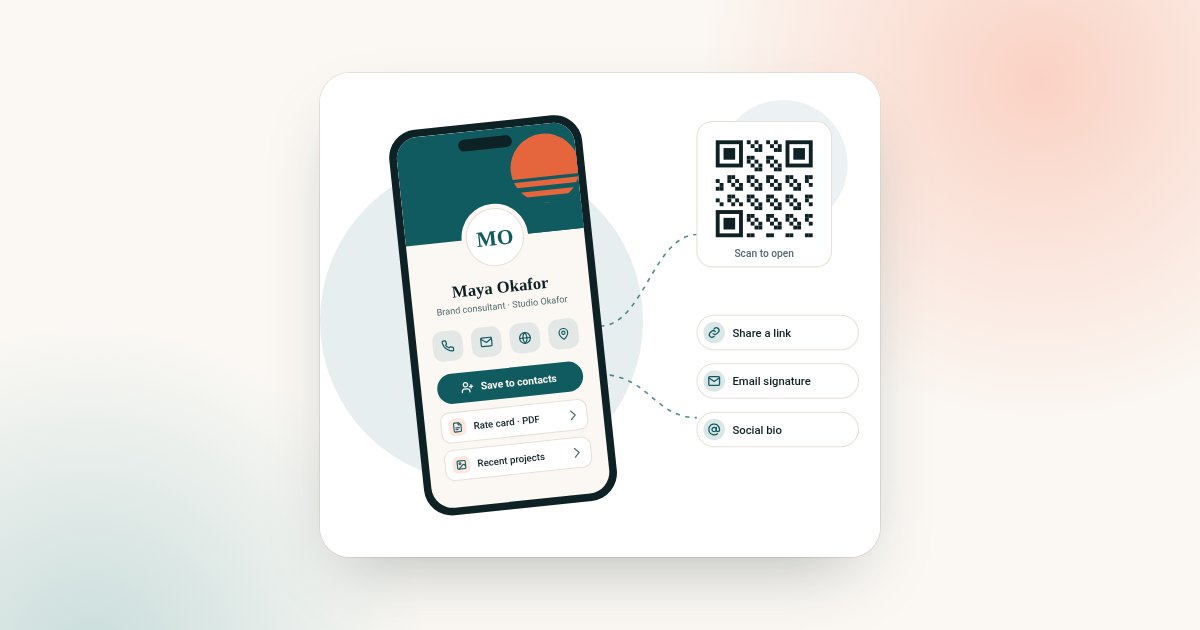
A digital-only card is the profile itself, shared without hardware. You show a QR code on your phone, send the link in a message or put it in your email signature. The other person opens your profile in their browser and saves your details.
This store sells digital profiles only, with no NFC cards or other hardware.
How an NFC card works behind the scenes
The chip in an NFC card holds a short web address. It does not hold your name, number or photo. Those live on the vendor's servers, in your profile.
That matters in two ways. First, editing your details happens on the profile, exactly as with a digital-only card. Second, the card only works while the profile it points to is online. The chip is a doorway, not the room.
A QR code works the same way. It holds a web address that opens your profile. The difference is that the QR code needs no chip, no card and no extra cost.
Do you actually need NFC?
For most people, no. Ask yourself three questions.
Will your contacts' phones read it?
NFC depends on the phone. Apple says that on iPhones that support background tag reading, the phone reads NFC tags without an app, but only while the iPhone is in use (Apple developer documentation).
On Android, NFC depends on the model. Google's help pages tell people to check whether their device supports NFC and to turn it on in settings (Google help). Some people will have it switched off.
QR codes are more universal. Apple says you can scan a QR code with the iPhone Camera app or from Control Center (Apple support). Most Android phones can scan one from the camera or a built-in scanner, though the steps vary by maker.
Is the hardware worth the cost?
An NFC card is a product you pay for, on top of any plan. On their own websites, Mobilo lists cards from $19.99 to $139, Linq lists products from $12.99 to $29.99, and V1CE lists cards from £60. Prices checked on 31 October 2026.
Cards can also be lost, bent or left behind. Each new member of a team needs one. If a design changes, you may want new cards.
What does it add that a QR code does not?
A small moment of theatre. Some people enjoy handing over a card, and some contacts remember it. If that matters for your brand, an NFC card can be worth it.
But the profile the other person sees is the same. A QR code on your phone gets them there too, with nothing to buy.
NFC card vs digital-only card at a glance
| Compared | NFC business card | Digital-only card (QR code and link) |
|---|---|---|
| What you carry | A physical card | Your phone |
| How people open it | Hold a compatible phone near the card | Scan the QR code or open the link |
| Works on | Phones with NFC switched on | Almost any phone with a camera or a browser |
| Works remotely | No, needs to be in hand | Yes, by link in email, chat or video calls |
| Hardware cost | Yes, per card | None |
| Can be lost | Yes | No |
| Updating your details | Edit the profile | Edit the profile |
| What the other person sees | Your hosted profile | Your hosted profile |
QR code plus link: the universal option
A QR code and a link together cover almost every situation.
- In person: show your QR code. People scan it with their camera.
- In a message: send the link with one line of context.
- In email: put the link in your signature.
- On video calls: paste the link in the chat or show the QR code on screen.
- On your own printed materials: print the QR code on slides, signs or paper cards.
An NFC card only covers the first of these. That is why we built a digital-only card. Our guide on how to share a digital business card on WhatsApp, LinkedIn and email covers each route.
What about QR codes that stop working?
A fair worry. Some QR codes depend on a subscription and stop working when it ends. Our guide do QR codes expire? explains static and dynamic codes. On this site there is no subscription, so there is no payment that can lapse.
The same question applies to NFC cards. The chip points to the vendor's profile page. If that page goes offline, the card stops being useful.
A worked example: a team of five
A small sales team wants cards for five people.
With NFC hardware, each person needs a card on top of any plan. At Mobilo's lowest listed card price of $19.99, five cards come to $99.95 before any monthly plan. At V1CE, five cards start from £300. Prices checked on 31 October 2026 on each vendor's own site.
With digital-only cards here, five Brand Presence profiles cost $360 once. There is nothing to post, nothing to lose and nothing to reorder when someone joins.
If the team works trade shows where a physical card makes an impression, the hardware may still be worth it. If not, the QR code does the job.
Questions to ask an NFC card vendor
- Does the card need an active subscription to work?
- What happens to the card if I stop paying?
- Does the card also carry a QR code, for phones without NFC?
- Can I change the profile the card points to?
- What does a replacement card cost if one is lost?
- Is the software price separate from the card price?
When an NFC card makes sense
Be fair to the hardware. It is a good choice if:
- handing over a physical object is part of your brand;
- you work at events where people expect a card;
- your contacts mostly use phones that read NFC; or
- you want a premium object, such as a card made of metal.
If that is you, compare vendors that sell NFC cards in our best digital business card guide.
When digital-only makes more sense
- You share by link and email as much as in person.
- You do not want to buy, carry or replace hardware.
- You are buying for a team and want nothing to post to each person.
- You want the lowest total cost. Our digital vs paper business cards guide compares costs over three years.
Ready to buy a digital-only card? See the plans on the digital business card page.
Frequently asked questions
What is the difference between an NFC business card and a digital business card?
An NFC card is a physical card with a chip that opens your profile when a phone is held near it. A digital-only card is the profile itself, shared by QR code and link, with no hardware.
Do I need an NFC card to have a digital business card?
No. A QR code and a link open the same profile on almost any phone. This store sells digital-only cards, with no NFC card.
Do all phones read NFC business cards?
No. It depends on the phone and its settings. Apple says supporting iPhones read tags in the background while in use. Google tells Android users to check that their phone supports NFC and that it is switched on.
Are NFC business cards worth it?
They can be if a physical card matters to your brand. They cost extra and can be lost. For most people, a QR code and a link do the same job.
Can I print my QR code on a paper card instead?
Yes. Printing your QR code on your own paper card works on almost any phone camera, and the code opens your live profile.
Can an NFC card stop working?
Yes, if the profile it points to goes offline. The chip only holds a web address, so the card depends on the vendor keeping your profile running.
Does this store sell NFC cards?
No. This store sells digital profiles only, shared by QR code and link. Nothing is printed or posted.